Featured Posts

Sandos Hotels awarded with TripAdvisor Certificate of Excellence Our hotels in Spain, Sandos Monaco Beach Hotel & Spa, Sandos Papagayo Beach Rerort and Sandos San Blas Nature Resort & Golf have been awarded...

Read More

NEW Teens Club at Sandos Playacar Beach Resort & Spa It’s here! Sandos Playacar Beach Resort & Spa just launched the brand new Lite Teens Club, and it’s pretty cool. Exclusively for ages 12 –...

Read More

The Grand Opening of Sandos Finisterra Los Cabos Sandos is going west coast! On May 1, we launched Sandos Finisterra Los Cabos: our newest resort in the ruggedly beautiful beach destination of Los...

Read More

Be There When Criss Angel Films at the Sandos Finisterra Los Cabos Resort! See the magic of Criss Angel come alive before your eyes while surrounded by the unbelievable beauty of Los Cabos. From June 24 – 29, world famous...

Read More

8 Ways to Enjoy a Summer Vacation with the Family Summer is almost here! And we bet the kids are already daydreaming about how to spend a sunny beach vacation now that school's out. Our family beach resorts...

Read More

Sandos San Blas celebrated the “Gánigo 2012″ Awards

Category : Uncategorized

Sandos San Blas Nature Resort & Golf, located in Tenerife (Canary Islands) celebrated the Gánigo 2012 awards ceremony, a recognition San Miguel de Abona city council gives this year to  honor the pay tribute to everyone who contributed during the year in the region development.

This event, celebrated every year by “Centro de Iniciativas y Turismo de las Comarcas del Sur de Tenerife”, attended almost 400 guests. An special mention was dedicated to all the professionals and volunteers who helped  extinguishing the fire that strucked the island last summer.


 The winners this year have been:

•  Hotels, Hoteles Reverón.

• Shop and craft, Centro Comercial Abora y Chafiras S.A.

• Amusement and entertainment, Karting Club.
• Restaurants, bars and discos, El Lajar de Bello.
• Travels, Canarias .com

- Adeje, Asociación Española contra el Cáncer, AECC.
- Arico, D. Ramón Desiderio Martín Flores.
- Arona, Escuela de Folklore de Arona.
- Granadilla de Abona, Sociedad Cultural José Reyes Martín.
- Guía de Isora, Club de Surf Punta Blanca.
- San Miguel de Abona, Sociedad de Instrucción y Recreo Club Casino San Miguel.
- Santiago del Teide, Restaurante El Rincón de Juan Carlos.
- Vilaflor, Fuente Alta.

Special Mention: Radio FM los 40 Principales Sur Tenerife.


Honorable mention: professionals and volunteers who helped on the south of Tenerife forest fire extinguishing.

Photography: Rafael Mendiguchía Díaz

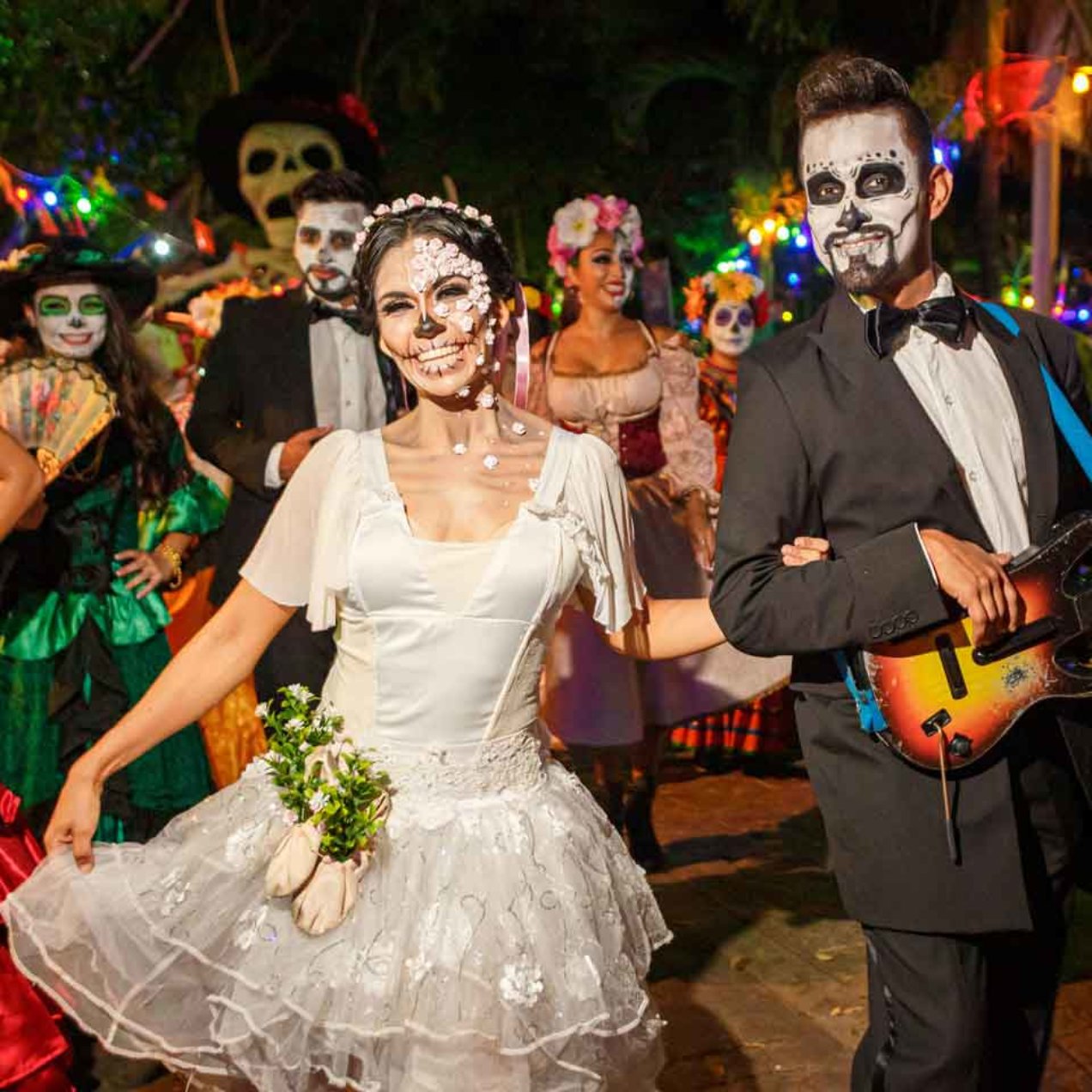
Sandos Hotels and Resorts Celebrate Dia de Los Muertos November 1-2, 2012

Category : Uncategorized

Sandos Hotels presents Dia de Los Muertos October 31-Nov 2: Parades, altars, traditional foods, and cultural displays and performances

Day of the Dead or Día de los Muertos is an annual holiday celebrated throughout Mexico on November 1st and 2nd. During these days, families gather to honor, celebrate, and remember the lives of deceased relatives and friends. Many families build private alters in their homes or on gravesites to honor their deceased.  These altars typically feature symbolic objects or ofrendas (offerings) such as sugar skulls, marigolds, favorite foods and drinks of the departed, pictures of or possessions of the deceased, and candles.  The purpose of these altars is to encourage visits from the departed souls.

Orange Mexican marigolds called cempasúchil are an important symbol of this holiday, as they are believed to attract the souls of the deceased.  Flowers are placed on graves and altars, and in some ceremonies the petals are removed and spread over the area. In modern Mexico, the marigold is often called Flor de Muerto (Flower of the Dead).

Another common symbol of the holiday is the skull (calavera), which celebrants represent in masks, called calacas (skeleton).  Skulls are also represented in foods such as sugar or chocolate skulls, which are inscribed with the name of the recipient on the forehead and given as gifts to either the deceased or the living. Additional foods include pan de muerto (dead man’s bread, sweet bread made from flour and eggs and shaped into skulls, animals, or bones.

Mexican families typically spend time together around their family altar praying and sharing memories and stories about the deceased. In some locations, celebrants wear shells on their clothing, so when they dance in celebrations, the noise will wake the dead and encourage them to visit the altar.  Pillows and blankets are often left near the altar so the deceased can rest after their long journey to visit their living friends and family. In some parts of Mexico, such as the towns of Mixquic, Pátzcuaro and Janitzio, people spend the entire night in the cemetery near the graves of their departed relatives. In many locations, people have meals at the gravesites.

Some families create short poems called calaveras (skulls) that describe the personalities, habits, or interesting stories related to the deceased. This custom originated in the 18th or 19th century, after a newspaper published a poem narrating a dream of a cemetery in the future in which “all of us are dead”, and “reading” tombstones.

Newspapers often publish calaveras of public figures, with cartoons of skeletons in the style of the famous calaveras of José Guadalupe Posada, a Mexican artist. Posada created a famous illustration of a figure he called La Calavera de la Catrina (“skull of the rich woman”) as a parody of a Mexican upper-class female. Posada’s image of a costumed female with a skeleton face has become an iconic symbol associated with of the Day of the Dead, and Catrina figures often are a prominent part of modern Day of the Dead observances.

For more information about Dia de Los Muertos guests can visit the Smithsonian Latino Center’s  virtual Day of the Dead Theatre


A New Era: A Mayan Celebration of Life and Hope at Sandos Caracol December 21-22, 2012

Category : Uncategorized

According to archeological studies in ancient Mayan cities throughout Mexico and Central America, the Mayan calendar has three main counts or forms: The Lunar or Feminine Count (Tun’Uc), which represents the cycles of moon, the Tzokiln, recording the cycles of the sun, and the Long Count (Cuenta Larga), representing the cycles of the major planets in earth’s solar system. Many archeologists suggest that the Mayans believed that each Long Count could bring significant change and rebirth to their communities.

Mayan astronomers calculated this Long Count calendar and cycle, which has been supported by modern astronomical studies, with the most basic tools. They recorded these calendars in pictograms, etched in stone, that we, as modern visitors, continue to view today in the Mayan archeological preserves of Xcalacoco, Kohunlich, Coba, Chichen Itza, and Tikal.

The Mayan Long Count will end on December 21st, 2012, when all of the major planets in earth’s orbit will align in a cycle that only occurs every 26,000 years. Most modern investigators, and many modern Mayans, believe that the planets will then begin a new 26,000-year revolution or “Long Count” — a new cycle.

In keeping with our underlying mission and model of offering unique environmentally and culturally sustainable programs, Sandos Caracol Eco-Resort and Spawill present a series of Mayan ceremonies and cultural events created to mark the end of the Mayan Long Count.

On December 21-22, 2012 in Xcalacoco, we invite guests to celebrate a transition to the beginning of what we, and many Mayan leaders and scholars, hope will evolve into a new era of environmental sustainability and cultural consciousness, rooted in ancient Mayan beliefs and practices.

Sandos Caracol will present several events in honor of the Mayan traditions and communities that have, for centuries, existed on the indigenous Mayan land of Xcalacoco, located a side of Sandos Caracol Eco Resort & Spa property:

  • A documentary video about Mayan culture in our theater and on television monitors throughout the property
  • A reproduction of a traditional Mayan Village on our main beach
  • A series of Mayan ceremonies written and performed by local artists and community members
  • Traditional Mayan arts and crafts produced and presented by local artisans
  • Temazcal ceremonies (extra fee)
  • An academic presentation on Mayan culture and the Mayan calendars
  • Photo exhibition on Mayan Culture


Sandos Caracol Hosts A Visit From Award-winning Photojournalist Jace Rivers

Category : Ecology, Sandos News

On October 19th and 20th, 2012 Sandos Caracol Eco Resort and Spa had the pleasure of hosting Jace Rivers, a US-based photographer, who visited Sandos Caracol to create a photo pictorial of the Xcalacoco Experience and our Mayan ceremonies.

An internationally award-winning photojournalist, Jace specializes in outdoor photography and has covered stories in over 40 countries.  His photographs have been featured in publications such as National Geographic, Outside Magazine, AsiaSpa, Traveler, and Men’s Health.

Jace’s photos of Xcalacoco and the Mayan ceremonies will be featured in our in-room magazine and, later this winter, Sandos Caracol will offer selected prints for exhibition and sale in our guest relations area.

Sandos Hotels and Resorts will be publishing a full portfolio of this work in early November on a new website dedicated to our New Era celebration scheduled to take place on December 21-22, 2012. We look forward to sharing Jace’s work with our visitors, and are very honored to have worked with such a talented and dedicated photojournalist.


Corazon y Vida Maya: Sandos Caracol Launches a New Partnership in Sustainable Tourism

Category : Social

On October 12, 2012 Sandos Caracol ECO Resort and Spa hosted a press conference to announce the launch of a new initiative to offer alternative tourism packages to our visitors.  In keeping with our mission to promote sustainable tourism practices, Sandos Caracol will be partnering with Corazon y Vida Maya (Heart and Life Maya), a local organization working to promote, revitalize, and preserve the cultural practices of their Mayan ancestors.

These new tourism packages are operated by seven rural Mayan villages on the outskirts of the town of Felipe Carrillo Puerto, approximately two hours south of Sandos Caracol.

This program is scheduled to begin in the winter of 2012-13 and guests of the hotel will be able to purchase tour packages from Corazon y Vida Maya.  All profits from these tours will go directly to the communities, all of which suffer from a lack of financial resources.  By participating in these educational tours our hotel guests will be able to learn more about Mayan culture and history, while also ensuring that all fees go directly to these communities in need of financial support.

Sandos Caracol is excited and honored to be a part of this new venture in community action and cultural sustainability, and we encourage all of our guests to learn more about the project.  For more information visit Corazon y Vida Maya. 

Sandos Monaco will be present at the 5th “Fira de Tardor”

Category : Sandos News, Uncategorized

Sandos Monaco Beach Hotel & Spa will again be present at the Commerce, Tourism, Business and Gastronomy Fair, the 5th “Fira de TARDOR”, at L’Alfàs del Pi. It will start next Friday and you will be able to visit the commercial carp and enjoy the food and drinks routes during the whole weekend.

Sandos Monaco Beach Hotel & Spa

During this event, the Adults Only hotel, located in Benidorm (Costa Blanca) will promote their facilities, with special attention to the Spa, so in their stand there will be massages, manicure, pedicure, and facial treatments, reducing treatments, zone therapy or reflexology. Furthermore, they will make demonstrations of massage with bamboo sticks and scented sachets.

The fair will take place the next 19th, 20th and 21st of October during the festivities of themunicipality ofL’Alfasdel Pi. This year they are launching the new “Paseo de tapas” and “Paseo de copas” (food and drink tours).

Visitors will enjoy tastings, workshops, raffles, shopping, dining, and entertainment for children and adults.

Sandos Hotels and Resorts: Caring for Local Animals and Wildlife

2

Category : Ecology


 At Sandos Hotels and Resorts, as part of our company's core vision and mission, we aim to incorporate an active and comprehensive policy regarding ecological sustainability and care for our global environment. These policies include our practices towards the care of captive and wild animals that our visitors encounter on our properties.

In our main eco-resort, Sandos Caracol Eco Resort & Spa, all of the animals contained in enclosures, are indigenous to the region. Many of these animals suffer from poor care and ill health in both captivity and the wild. Our resident donkeys and dogs, for example, were adopted from areas in the Yucatan and would likely live without proper care if we had not given them refuge.

 Our intention is to enact thoughtful and well-planned sterilization and breed and release programs for these animals, so populations that may grow out of control, such as cats, dogs, deer, or raccoons will self-regulate and not have to depend on human care or suffer from poor care and poor health.
 Through this program we also intend to aid animals that may be in danger of extinction or unaccustomed to human care, such as deer, birds, and sea turtles, to return to their natural habitats into local wildlife zones that have little or no human infrastructures or activities.

While we do not run any official animal shelter or rescue programs, Sandos Hotels and Resorts aims to provide — when possible– temporary or permanent care for both wild and captive animals that require rescue and rehabilitation. We are proud to offer our “Cat Cafes” to wild cats that live on our properties. Through these feeding and water stations, we support the work of local animal shelters including Coco’s Cat Rescue, well-known for their extensive work in animal rescue and sterilization.


Sandos is also pleased to announce that we were recently successful in ending a long-term contract that allowed for the display and photographic rights of captive animals to interact with guests in Sandos Caracol. This contract preceded Sandos’ acquisition of the Caracol property. We have prohibited animals from being used for profit in photographs in Sandos Caracol as of August, 2012.


We encourage our guests to experience and also respect the local wildlife. An integral part of this is to view them and enjoy their activities, but to refrain from feeding any wild animal. This includes the many wild raccoons, monkeys, birds, wild cats or dogs, fish, and coati that live on our properties.


At Sandos we aim to promote an awareness of and an appreciation for our local wildlife and habitats, and we hope that our guests will participate in our conservation practices when interacting with animals who live on and also populate our properties.


Mayan Honey Treatments: A Special Spa Experience At Sandos Caracol

Category : Ecology, Sandos News

According to the National Honey Board, Americans consume about 1.3 pounds of honey per person each year. Now more than ever, people are realizing the amazing versatility of the all-natural ingredient. Its sweet taste is old news, but the popularity of honey and it’s skin-saving benefits is making its way into many beauty products and treatments. Honey is a humectant, so it attracts and retains moisture which makes it ideal for cleansers, creams, shampoos, conditioners and spa treatments.

Home to a Mayan honeybee colony on site, The Sandos Caracol Eco-Resort & Spa located in the Mexican Caribbean, infuses local culture and traditions into their spa treatments. In an effort to protect the endangered specials, the resort is home to a Mayan honeybee colony. Twice a year a Mayan Shaman performs a ritual bee ceremony, which requests permission from the bees to extract honey for use in the spa’s rituals such as the Nourishing Ancient Maya Ritual, a therapeutic treatment that feeds the skin with vitamins and nutrients.

Sandos Hotels and Resorts Participates in the International Coastal Cleanup

Category : Ecology

On September 29th, Sandos Hotels and Resorts participated in the International Coastal Cleanup, an annual event sponsored by the Ocean Conservancy, to clean and care for beaches and waterways.

We thank all of our Sandistas for volunteering their time in this important event. Again, this year, we reached our goal of having 50 Sandistas participate in this very important ecological cause. The data from our effort has been delivered to SOFEMAT so we can track the impact Sandos Caracol has generated in this very important international cleaning and so we can also learn more about how to control waste in our oceans and waterways.

We are very proud of this work and congratulate and thank our hotel staff for their efforts.

Mangrove Crab Reproduction At Sandos Caracol

2

Category : Uncategorized

During the months of September and October guests at Sandos Caracol Eco Resport and Spa will have an opportunity to witness the peak time in the reproductive cycle of mangrove crabs.

These large, land-dwelling crabs live in and among mangroves, and they have a variety of significant ecological roles. They maintain the energy chain in mangrove areas by burying and consuming vegetative debris, and they contribute to the airation and health of the ground by burrowing their large holes in the earth and mud.

Mangrove crab eggs, which they lay on the edges of the water, provide a key food source for young fish.  Mangrove crabs, themselves, are also a key source of food for threatened birds, such as the Crab Plover.

Removing these crabs from an area has been shown to cause increases in chemicals such as sulfides and ammonium which negativly impacts the overall health and productivity of the mangrove forest.

Visitors to Sandos Caracol can learn more about the important role of these crabs by reviewing some of the following resources:

Smithsonian Marine Station

Network of Aqauculture Centers

Mud Crab Aquculture